
Apr
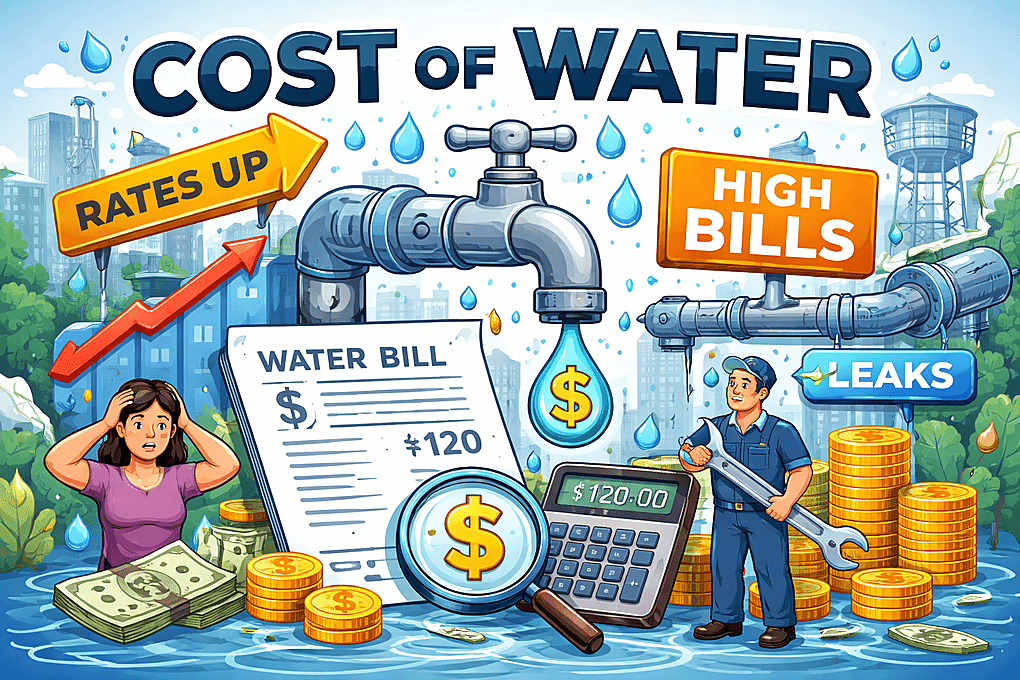
Water has always been essential. What’s changed is how much it costs. And why? Across the U.S., water rates are climbing, driven by a “perfect storm” of crumbling infrastructure, new federal mandates, and explosive industrial demand.
While annual increases might seem incremental, the cumulative trend is staggering. Here are six things you need to know about the economics of water in 2026.
Water Costs Are Consistently Outpacing Inflation
We are officially in a period of sustained “Water Inflation.” Following the 5.1% jump in 2025, rates have continued to climb faster than the Consumer Price Index (CPI).
- The 5-Year Surge: Household water costs have risen more than 24% since 2021.
- Structural, Not Seasonal: Unlike energy prices, which fluctuate with commodity markets, water increases are baked into the system to cover fixed debt and regulatory compliance.
Location, Location, Location (The 10x Gap)
There is no such thing as a “national average” when it comes to your tap. The price disparity across the country is widening:
- The Range: Some municipalities still enjoy water at $0.001 per gallon, while water-stressed or infrastructure-heavy regions are seeing rates exceed $0.01 per gallon.
- The Drivers: This 10x difference is dictated by whether a city relies on local groundwater or expensive “imported” water, the age of its pipes, and local climate resilience policies.
The “Invisible” Cost: Regulatory Compliance & PFAS
Infrastructure isn’t just about fixing leaky pipes anymore. In 2026, utilities are grappling with the massive capital costs of:
- PFAS Removal: New EPA standards for “forever chemicals” have forced many utilities to install expensive carbon filtration or ion exchange systems.
- Lead Service Line Replacement: The federal push to eliminate lead lines has reached a fever pitch, with the costs being passed directly to the ratepayer.
Note: Your bill is likely rising not because you are using more water, but because the water you do use requires more complex “manufacturing” to be safe.
The End of “Rate Shock” (But Not Rate Hikes)
Utilities are moving away from emergency price jumps in favor of Multi-Year Rate Plans (MYRPs).
- Predictability: These plans lock in annual increases (e.g., 4–6%) for 3 to 5 years at a time.
- The Trade-off: While this prevents “sticker shock,” it makes price hikes a permanent, expected fixture of household budgeting. The question is no longer if rates will rise, but how many years the current hike cycle will last.
New Demand: AI Data Centers and Landscaping
We are seeing a shift in who is thirsty. While residential conservation has improved, industrial demand is putting new pressure on the grid:
- The Tech Factor: The continued expansion of AI data centers requires millions of gallons for cooling.
- The Outdoor Drain: In suburban regions, lawn irrigation still accounts for nearly 40% of summer usage, often triggering “peak tier” pricing that makes summer bills disproportionately high.
Efficiency is the Only Hedge
The average U.S. family now spends over $1,100 per year on water and sewer services. In 2026, efficiency is no longer just a “green” choice, it’s a financial necessity.
- The ROI: Investing in smart irrigation or high-efficiency fixtures now has a shorter payback period than ever before.
- System Longevity: Reducing demand doesn’t just save the individual money; it delays the need for the utility to build a new multi-billion dollar treatment plant, which helps keep local rates lower for everyone in the long run.
Water pricing in 2026 reflects a broader shift: water is being repriced to reflect its true value. As it moves from a “cheap utility” to a “managed asset,” how we apply technology to monitor and reduce waste will define the next decade of water management.
Explore ways to improve water efficiency and better understand irrigation costs.
The Husqvarna Water Management System dashboard provides water cost tracking and reporting, supporting fixed, tiered, and seasonal pricing while delivering export-ready insights for budgeting and forecasting.
Learn more about Water Cost Tracking & Reporting.