
Mar
Most people water their landscapes based on guesswork. A little here, a little there, adjust the timer when things look dry, and hope for the best. But there’s a number—a simple coefficient—that tells you exactly how much water each plant needs. It’s called the plant species factor, and understanding it can cut your water use by 30% or more. Let’s break down what the plant species factor is, why it matters, and how you can put it into practice for better water savings.
What Is the Plant Species Factor?
The plant species factor, also called the crop coefficient or Kc, is a multiplier that represents how much water a specific plant needs compared to a reference standard. It’s based on decades of agricultural and horticultural research and accounts for factors such as leaf area, root depth, growth stage, and water-use efficiency.
Every plant species has its own specific coefficient. Tomatoes, roses, Bermuda grass, and fescue all differ. Knowing these numbers lets you manage water as a resource, not just a bill to pay.
How It Works
The formula is simple:
Water Need = Reference ET × Plant Species Factor
Reference ET (evapotranspiration) is the baseline water loss from soil and plants on a given day. You can get this from local weather stations, university extension services, or smart irrigation controllers that automatically calculate it. The plant species factor adjusts that baseline up or down depending on what you’re growing.
Example: San Diego in June has a reference ET of about 0.23 inches per day.
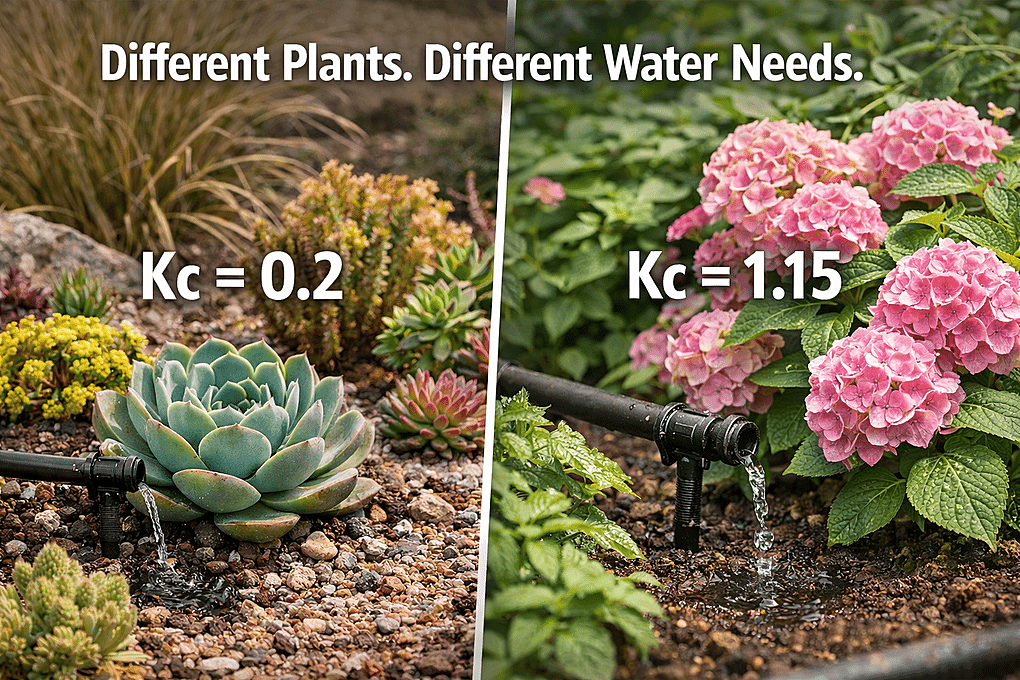
Tomatoes at peak growth have a species factor of 1.15. Multiply: 0.23 × 1.15 = 0.26 inches per day.
Drought-tolerant succulents have a factor of around 0.2. Multiply: 0.23 × 0.2 = 0.05 inches per day.
Same day. Same location. Completely different water needs.
If you water both the same amount, you’re either drowning the succulents or starving the tomatoes. Neither is efficient.
Why This Matters for Water Conservation
Here’s the problem: most irrigation systems treat every zone the same. They run for the same amount of time, at the same frequency, regardless of what’s planted there.
A zone with mature oaks and native shrubs (low water need) often receives the same schedule as one with annual flowers and vegetables (high water need). The result is overwatering in some areas and underwatering in others.
The plant species factor solves this. Knowing each zone’s needs allows you to adjust run times accordingly. You only apply water where it’s needed. The savings add up fast. Adjusting irrigation based on plant factors instead of guessing can reduce outdoor water use by 30% or more—without sacrificing plant health. In many cases, plants actually perform better because they’re not stressed by too much or too little water.
The Species Factor Changes Over Time
One more thing people miss: the species factor isn’t static. It changes as plants grow.
Take tomatoes. Right after you transplant them, the factor is around 0.6. Small plants, shallow roots, low water demand. By mid-season, when they’re fruiting, the factor jumps to 1.15 or higher. Full canopy, deep roots, peak water use. Late in the season, as fruit ripens, it drops back to 0.8 or 0.9.
Set your irrigation in May, but never adjust it? You’ll overwater early, underwater at peak, and return to overwatering at the end. The factor indicates when to adjust.
Lawns do the same thing. Cool-season grasses have higher factors in spring and fall, when they’re actively growing, and lower in summer, when they go semi-dormant in the heat. Warm-season grasses flip that—higher in summer, lower in spring and fall. Matching your irrigation schedule to the plant’s growth stage is where real efficiency happens.
How to Use This in Practice
You don’t need to be a scientist to use plant species factors. Here’s how to apply this:
Step 1: Know what’s in each zone. Walk your property. Make a list. Zone 1: Bermudagrass. Zone 2: Native shrubs and oaks. Zone 3: Vegetable garden. Zone 4: Roses and perennials.
Step 2: Next, look up the species factors. University extension services provide these numbers. Search for ‘crop coefficient’ plus your plant type. For a comprehensive reference, my book Waterwise Gardening (Rizzoli) includes species, root depths, and water requirements for many landscape plants. If using a smart controller, many have this data included.
Step 3: Adjust your run times by zone. If Zone 1 (turf) has a factor of 0.8 and Zone 2 (natives) has a factor of 0.3, Zone 2 should run about one-third as long as Zone 1. Don’t run them the same.
Step 4: Adjust seasonally. As plants grow or go dormant, tweak the schedule. You don’t have to recalculate daily, just adjust a few times per year as growth stages change.
Step 5: Let technology help. Smart irrigation controllers calculate reference ET and automatically apply species factors when you tell them what’s planted in each zone. You set it once, and the controller adjusts daily based on the weather. That’s the difference between managing water and just turning on a timer.
What We’re Building
This is exactly why we’re working on a plant database tool that gives contractors and property managers instant access to plant species factors, root depths, and water requirements for thousands of plants. No more hunting through extension publications or flipping through reference books.
Enter the planted species, and the system provides the water requirements. Adjust your controller as directed.
The technology and data are here. What’s missing is an easy way to connect them. That’s what we’re fixing.
The Bottom Line
Water isn’t unlimited. Prices are rising. Regulations are tightening. Guessing doesn’t work anymore. The plant species factor is one of the most powerful tools in water management, and most people don’t even know it exists. Learn the numbers for what you’re growing. Adjust your zones to match. Stop treating every plant like it needs the same amount of water.
Making watering precise through the plant species factor is straightforward. That precision is what actually achieves meaningful water conservation, simple, effective, and future-ready.