
May
For decades, irrigation was a guessing game. We set mechanical timers to run for twenty minutes at dawn and hoped for the best, which often resulted in water running down the gutter on rainy days or parched turf during a heatwave. Today, that old school guesswork is being replaced by smart technology that actually listens to the environment. But for all the talk about smart controllers, there is one scientific concept doing the heavy lifting: evapotranspiration, or “the ET”.
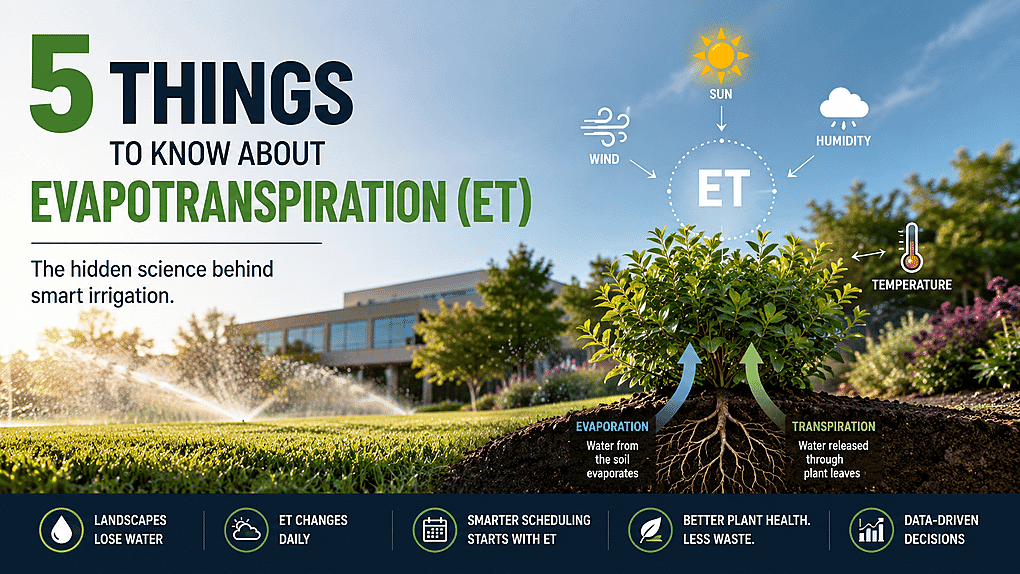
Forget the extra terrestrial. Here are 5 things to know about the other ET, the one that actually keeps your plants grounded:
ET Is How Landscapes Lose Water
To understand why ET matters, start with what is actually happening in a planted landscape on any given day. Water is leaving the system constantly through two distinct pathways working in tandem.
The first is evaporation: moisture releasing directly from the soil surface and from any water sitting on leaves or mulch. The second is transpiration, the process by which plants pull water up through their roots, use it in photosynthesis, and release water vapor through tiny pores in their leaves.
Think of it as a simple equation: Evaporation (Soil) + Transpiration (Plants) = ET. It is essentially the thirst of your landscape. Scientists merged these two inseparable processes into this single term to measure how much water a landscape loses to the atmosphere over a given period.
ET Changes with Weather Conditions
Evapotranspiration is not a fixed property of a plant or a soil type. It is a dynamic response to environmental conditions.
Temperature drives it upward. So does solar radiation, because sunlight accelerates the biological processes that push water through plant tissue. Wind strips away the thin layer of humid air that accumulates around foliage, accelerating moisture loss. Even humidity plays a role: low humidity creates a thirstier atmosphere that pulls moisture out of leaves faster, much like how a towel dries quicker in the desert than in a rainforest.
Consider a July afternoon with high heat, full sun, and gusting winds. A landscape can lose water at a rate dramatically higher than it would on a mild, overcast day in May. A traditional timer based irrigation system knows nothing about this. It waters on schedule regardless, applying the same amount of water whether the landscape is thirsty or not.
This Is What Helps Make Smart Irrigation “Smart”
The phrase smart irrigation is often applied to any controller that is internet-connected via Wi-Fi or cellular, or simply because it features a mobile app. But the deeper intelligence comes from systems that ingest real environmental data to recalculate water demand continuously.
Modern ET-based controllers use either on site weather sensors or regional data networks to calculate exactly how much water a landscape has lost since the last irrigation cycle.
Think of the soil like a savings account. ET is the daily withdrawal made by the sun and wind. An ET-based controller tracks those withdrawals and only deposits (waters) exactly what was spent to keep the balance steady. The schedule is no longer a static program running on autopilot; it becomes a dynamic response to what the landscape has actually experienced.
ET Improves Precision, Not Just Savings
It”s tempting to say ET-based irrigation is primarily a water conservation tool. While savings are a real outcome, the true goal is precision: applying the right amount of water at the right time.
Both overwatering and underwatering create significant problems. Too much water leads to shallow root development, runoff, and fungal disease. Too little stresses plants and degrades appearance.
When ET-based scheduling works as intended, it narrows the window between those two failure states. Root systems develop more deeply because they are encouraged to seek moisture rather than finding it pooled at the surface. Moisture levels stay more consistent, which stabilizes plant health. The landscape performs better, and water savings follow as a natural consequence of precision rather than as the primary objective.
Different Landscapes Respond Differently to ET
ET does not apply uniformly across every plant type or every zone. A stand of mature trees has a very different ET profile than a turf area or a bed of low water shrubs.
Trees have deep root systems accessing moisture reserves that surface irrigation barely touches. Turf is highly responsive to immediate heat and wind. Each zone on a property is effectively its own micro ecosystem, losing water at its own rate in response to the same weather conditions.
This is why ET informed irrigation requires granularity. Zoning, plant type, and microclimate exposure all feed into how ET calculations translate into actual run times. A system that treats a south facing turf slope and a shaded shrub bed as interchangeable is leaving efficiency on the table.
From Fixed Schedules to Informed Water Management
Smart irrigation is not just an appliance upgrade. It’s a shift in logic, moving from calendar based routines to continuous, condition aware responses. Evapotranspiration (ET!) is the scientific foundation that makes that shift possible.
The smart controllers proliferating across the country today in replacement of standard timers or “dumb clocks” from the past are only as smart as the data informing their decisions. At Husqvarna, by bringing together controllers, the B-hyve Pro mobile app, and the Husqvarna Water Management System dashboard into one powerful suite, the result is now total irrigation clarity. Allowing anyone, from a homeowner to professional alike, to stop guessing and, quite literally, watch ET in action.