
Feb
Every February 2nd, America pauses for one of its most charmingly ridiculous traditions: waiting for a groundhog to predict the weather.
But what most people don’t realize is that Groundhog Day isn’t a solo act. It’s a rivalry.
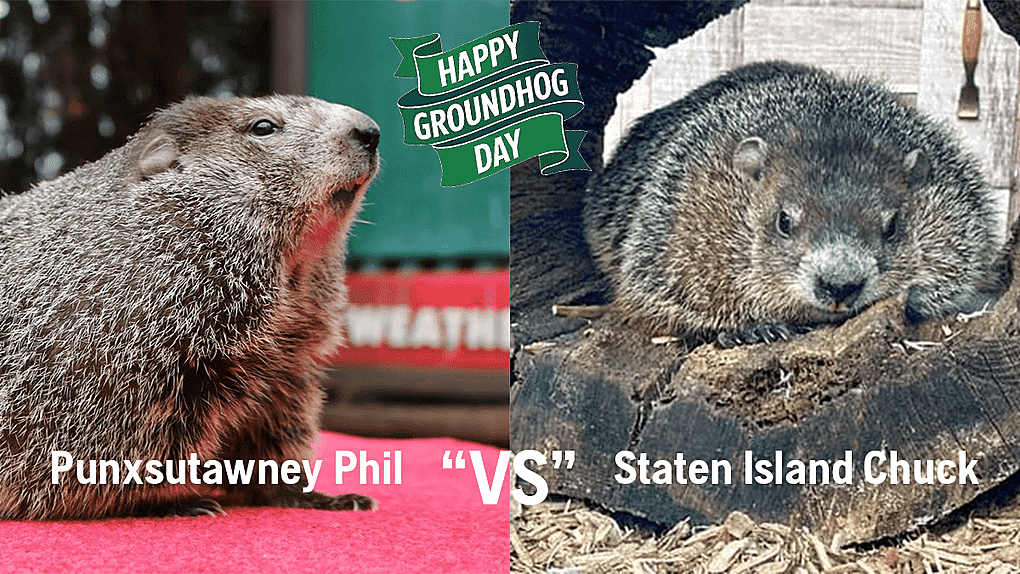
On one side, we have Punxsutawney Phil. A celebrity groundhog. He’s got the top hat, the crowds, the TV cameras, and even a Hollywood movie named after him. Phil is Groundhog Day. If there were a red carpet for rodents, he’d be walking it.
On the other side is Staten Island Chuck, officially known as Charles G. Hogg. No top hat. No movie deal. No national TV spotlight. Just a quiet life at the Staten Island Zoo, and an 85% accuracy rate over the past 20 years.
Phil’s accuracy over the same period? About 35%.
Yet every year, when Groundhog Day rolls around, America listens to Phil.
This year, both groundhogs predicted six more weeks of winter after seeing their shadows. A rare moment of agreement in an otherwise competitive forecasting landscape. But historically, Chuck has been far more reliable. Meteorologists know it. The data proves it. Chuck has quietly been right while Phil has confidently… not.
And still, Phil gets the fame.
Why? Because we love tradition. We love spectacle. And we’re oddly comfortable trusting a familiar voice, even when the numbers suggest we shouldn’t.
If this rivalry feels familiar, it should. We see it everywhere. Flashy opinions versus quiet data. Gut feel versus measurement. “This is how we’ve always done it” versus “this is what’s actually happening.”
Groundhog Day, it turns out, is less about weather and more about how humans make decisions.
And sometimes, how we don’t.
Nowhere is this more obvious than in how we manage water.
For decades, irrigation has followed the Punxsutawney Phil model. We water based on tradition, fixed schedules, and assumptions. “It’s winter, so water less.” “It’s hot, so water more.” We look at the calendar, glance at the sky, and hope for the best.
Like Phil staring at his shadow, we make a guess and stick with it for weeks.
The problem? Landscapes don’t live on calendars. They live in soil, weather, and microclimates. And guessing wrong doesn’t just mean six more weeks of winter. It means wasted water, stressed plants, runoff, higher costs, and frustrated property owners.
This is where smart irrigation controllers step in, firmly on Team Staten Island Chuck.
Smart controllers don’t rely on ceremony or habit. They rely on data.
Modern systems use weather inputs, site-specific conditions, flow data, and historical performance to make decisions every single day. And increasingly, they use AI and predictive analytics to go one step further, not just reacting to what already happened, but anticipating what’s coming next.
Instead of waiting for rain and adjusting afterward, the system looks ahead. If cooler temperatures or rainfall are forecasted, irrigation is reduced or paused in advance. If heat, wind, or high evapotranspiration is coming, the schedule adapts to protect plant health without overwatering.
This isn’t guesswork. It’s forecasting. The kind that actually improves over time.
AI doesn’t get tired. It doesn’t rely on rules of thumb. And it doesn’t assume that last year looked like this year. It continuously learns from thousands of data points, refining irrigation schedules so they reflect reality, not tradition.
The result is an irrigation plan that’s adaptive, precise, and accurate. One that changes as conditions change. One that delivers healthier landscapes with significantly less water.
While Punxsutawney Phil checks his shadow once a year, smart irrigation systems are making better forecasts every day, quietly, consistently, and with far better results.
So enjoy Groundhog Day. Cheer for Phil. Tip your hat to Chuck. The rivalry is part of the fun.
But when it comes to managing water, the lesson is clear:
The best forecast isn’t the loudest or the most famous — it’s the one backed by data.
And in irrigation, just like on Groundhog Day, accuracy always wins.